The marvels of Darvel

It is one of the odder phenomenons in the history of furniture that a small town in Ayrshire should have produced a school of chair makers whose products are so recognisable and desirable. Darvel lies on the River Irvine about five miles east of Kilmarnock and the Irvine valley was at the centre of Ayrshire’s hugely successful linen, cotton and lace weaving industries. These industries supplied technology, craftsmen and customers for chairmakers which combined fortuitously with a plentiful supply of mature timber. These ash, elm and oak plantations had been created a hundred years earlier by a patriotic landowner and improver, the Earl of Loundon, who is said to have planted over a million trees on his estates during the middle decades of the eighteenth century. Later chairs incorporated American birch, especially for the seats, thanks to the trans-Atlantic trade from the Clyde estuary; it is likely that tradesmen trained in this tradition themselves crossed the Atlantic, exporting the style to east coast North America. Indeed, the form of the chairs, unique in the United Kingdom, will be familiar to students of east coast North American furniture.
Darvel chairs are generally associated with three makers John McMath (1797-1867), Hugh Shields (1823-91) and J Black, all of whom sometimes stamped their work. Similarities in the construction of the chairs suggest that Hugh Shields was possibly a successor to John McMath’s workshop. Shields had a son, also Hugh (1858-1903), who followed in his father’s profession. But most chairs are not stamped and it is clear that there were other makers or workshops involved in their production.
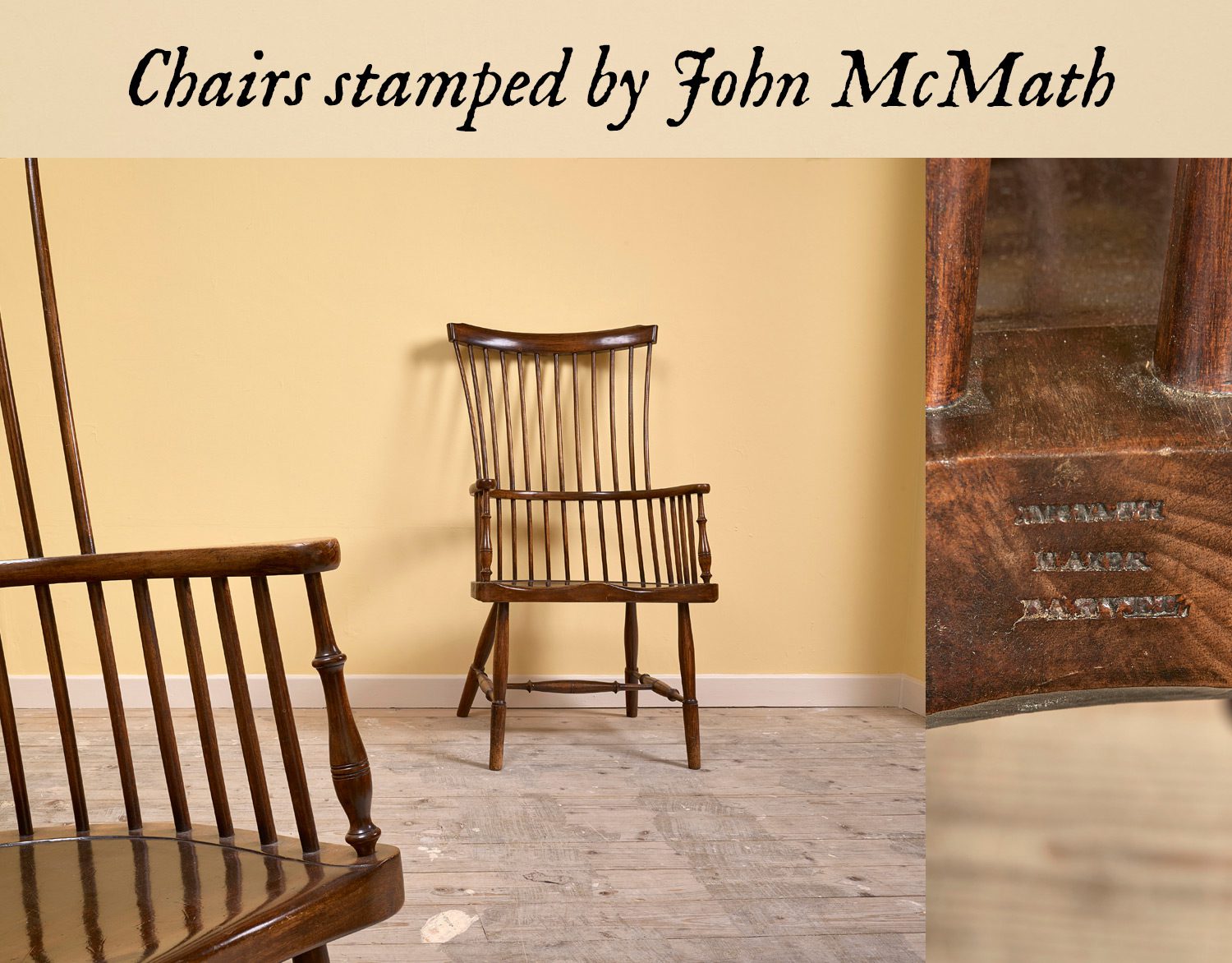
The chairs’ distinctive form seems to derive from a lowland model with the characteristic rake of the back and front terminal, the taller back with curved top rail and pronounced enclosing bow of the arms, all being found in older rustic versions originating in Scotland’s central belt. These features can be seen in a chair in the National Museums of Scotland’s collection which came from a farmhouse near Falkirk. The particular features developed in the Darvel area are the shaped seat with the lugs at the front and incised border, echoing the curved terminals of the arms, the turned front uprights supporting the arms and H-stretchers, tall back with curved top rail; these features are complimented by the exaggerated rakish overall aspect of the chairs with their pronounced backward lean, combined with strongly splayed legs which give them stability. It is this that makes them so comfortable. The spars are made using a rounding plane and are invariably the same size, leading to a suggestion that the same tools were passed from maker to maker; there are generally nine or ten to the back. Other elements are cut from solid (or naturally curved) timber rather than being steam bent; this is testified to by the following reminiscence of a local schoolmaster in 1904.
The joiners were John Mair, Hugh Rankin, Andrew Mair and John McMath. The last named was famouys for sharpening the shears of the cloth cutters, and for making ‘Windsor Chairs’. I remember him telling me how he knew almost every tree that had a suitable curve in its branches for such chairs.
The chairs were frequently originally finished with a basic shellac, whose orange tones can often still be seen, with a clear top coat of varnish which would deteriorate to a dark, almost black, crackled surface. The pair we currently have for sale show this very clearly.
For further reading see:
Bernard Cotton Scottish Vernacular Furniture 2008
Stephen Hunter ‘Darvel Chair Update’ Regional Furniture XV 2001
Stephen Hunter www.darvel-chairs.co.uk
David Jones ‘Darvel Chairs’ Regional Furniture IX 1995
Jason Sutcliffe Regional Furniture Newsletter No.71 Autumn 2019