The Penicuik House Armchairs

A pair of mahogany armchairs made by William Hamilton for the dining room at Penicuik House
Hamilton was paid £ 33 14/ 9d ‘in full of Chairs for Dining Room’ in 1772
Provenance: Sir James Clerk Bt, Penicuik House, Midlothian,
thence by descent in the family at Penicuik House.
Penicuik House was built by Sir James Clerk 3rd Bt, largely to his own designs, in the 1760s, replacing an earlier house close by (Newbiggin House) which his great-grandfather had purchased, together with the Penicuik estate, in the 1647.

Penicuik House, Midlothian, as originally built; note the stable block to the right
Sir James’s father Sir John was a Commissioner for the Union in 1707, subsequently becoming an MP and Baron of the Exchequer in Scotland, author of the heroic landscape poem The Country Seat, friend and patron of the poet Allan Ramsay and architect William Adam, Grand Tourist and a leading figure of the Enlightenment in Scotland. Although perhaps his 21st century fames rests on his status as the direct ancestor of James Clerk-Maxwell, one of the fathers of modern science.

Sir James Clerk 3rd Bt (1709-1783)
Sir James’s brother John married Susannah Adam, daughter of William Adam and sister of Robert Adam, whom he consulted when building Penicuik House. One of the glories of the house was the ceiling painted by Alexander Runciman in the Saloon, inspired by James Macpherson’s Works of Ossian (the room was subsequently known as Ossian’s Hall). This was complimented by a comprehensive furnishing scheme commissioned by Sir James from tradesmen in Edinburgh but also including various pieces purchased by his agents, including Robert Adam, in Italy. One of the gilt Rococo mirrors made by James Thomson of Edinburgh for Ossian’s Hall was recently purchased by National Museums Scotland.
Tragedy struck Penicuik House on a Sunday in 1899 when the household was at church and a fire spread throughout the entire house, all but destroying it. A significant amount of the contents were salvaged and the family took the decision to relocate to the adjacent magnificent stable block, also a creation of Sir James. This gave them the distinction of being the first landed family to forsake their seat for the stable block and Lady Clerk, and her successors, created a house of huge charm.

Penicuik House on the day of the fire in 1899; the wings had been added by David Bryce in 1857
Features such as marble chimneypieces and joinery were salvaged from the main house and reinstated, and the surviving furniture and paintings installed to create one of the most romantic and beautiful interiors in Scotland.

The Stable block at Penicuik with its famous spire and doocote modelled on Arthur’s O’on near Falkirk, believed at the time to be a Roman monument
This pair of chairs was ultimately displayed in the family’s new Drawing room with the primary contents of the house but originally formed part of the dining room suite.

Drawing room at Penicuik House in the 2010s with one of the chairs in situ below (see below for one of the dining chairs en suite); note the cockpen armchair at left of the photograph (detail of arm below)
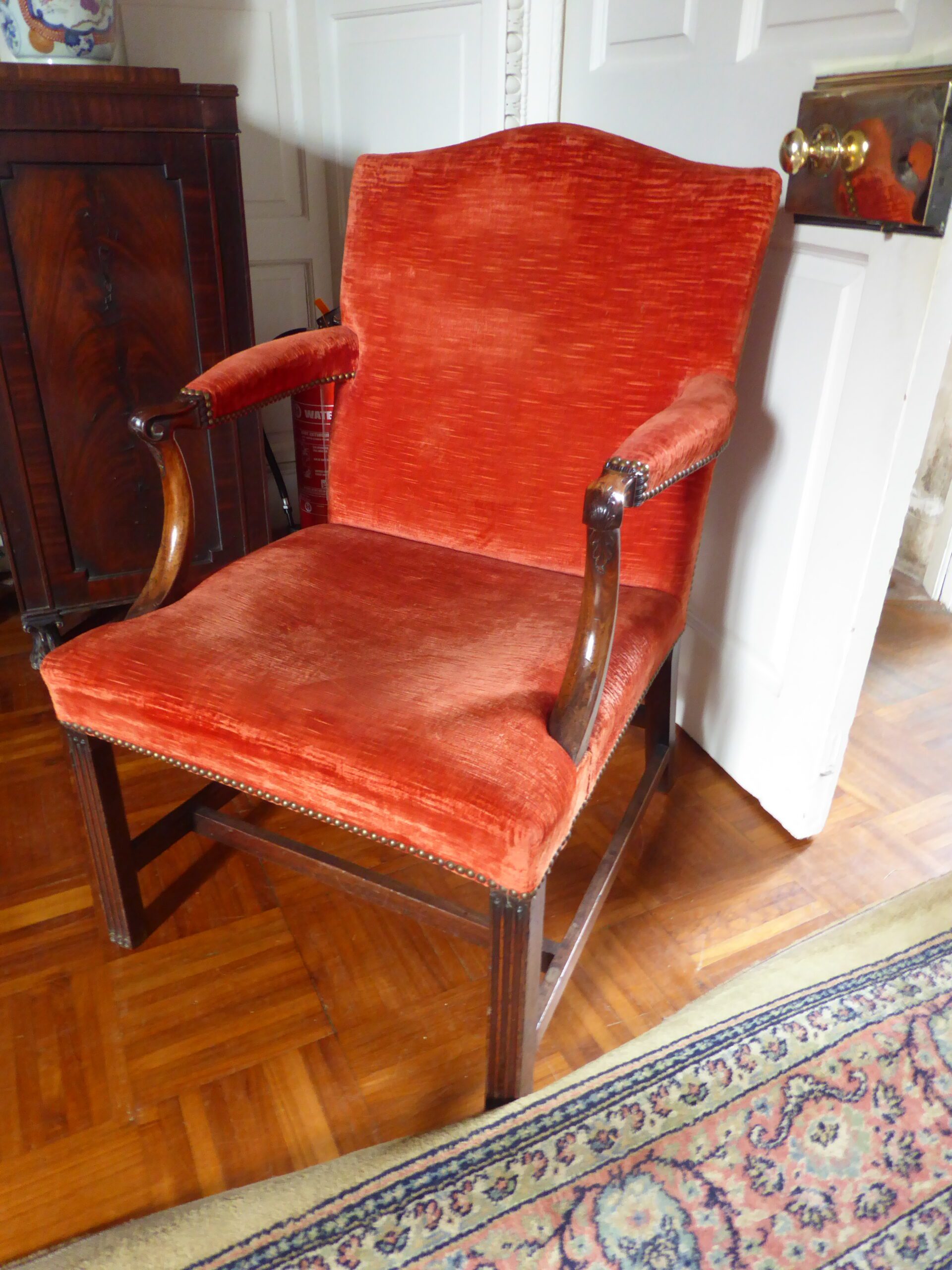

William Hamilton
The first record of William Hamilton is an account to the Duke of Argyll dated 1758 for ‘joining 2 Mahogany pattern Chairs that came from London’ and carrying out sundry mending of furniture[1]. It is not clear where this furniture was but the account was receipted in Edinburgh, and Hamilton was based there[2] until his retirement in 1790. He is a slightly mysterious figure, perhaps in part because he never advertised, but surviving accounts show him to have been making the finest furniture for some of the greatest patrons in Scotland.
Surprisingly Hamilton is not listed in the Register of Edinburgh Apprentices or the Roll of Burgesses, but he had become a burgess of Glasgow on the 20th May 1743. He worked extensively for the Dukes of Hamilton, who patronised their clansmen to a remarkable degree, and his second wife was the daughter of a tenant on the Hamilton estates[3]. His Glaswegian background was unique in Edinburgh during this period, but it seems to have done him no harm, although it is of note that he never registered any apprentices, and he may have been prevented from doing this. He did, however, join in partnership with James Caddell in 1766 (twelve years after Caddell’s partnership with Young and Trotter had been dissolved) for the specific purpose of undertaking funerals ‘in the most decent and … most elegant manner’[4]. It is not clear how long this lasted, but William’s son James was soon to start working with his father, and may have displaced Caddell[5]. In 1769 he signed a receipt ‘for my father’[6] and by 1773 was a full partner[7].
It was in the following year that James was consulted by Thomas Mowat of Shetland for advice about the furnishing of his new house at Belmont, Unst. His reply gives some interesting advice about ‘furniture made use of in the most fashionable houses’, and as Belmont was a classical two-storey three-bay house which probably had a similar amount of accommodation to a New Town house, this presumably can be taken as representative of taste in Edinburgh. The letter is quoted virtually in full in the Dictionary of Edinburgh Wrights[8] but certain sections repay attention, viz.
in the Drawing Room
1 Large or 2 small Sofas … Stuff’d Back and Seat or Chinese Chairs … Curtains for the windows and covers for the chairs and sofa of Damask Calicoe or moreen;
It is not recorded whether the Hamiltons supplied any furniture to Thomas Mowat, and he may have been simply wanting advice with which to guide a local cabinet maker, but this reference to Chinese chairs is most significant, linking the Hamiltons, at least on paper, to the distinctive Scottish type known since the 20th century as cockpen chairs. Nevertheless, they did make furniture according to their guidelines for a wide range of other clients, and were involved in several major furnishing schemes. Amongst these were the dining room, and other, chairs for Sir James Clerk’s newly built Penicuik House, Midlothian[9], the chairs of which are identical to a vast set made for Trinity House, Leith (see below)[10]. These sets are the only identifiable surviving pieces made by the Hamiltons and those at Penicuik can be confidently linked to the cockpen form.


Trinity House, Leith and a detail of one of the armchairs
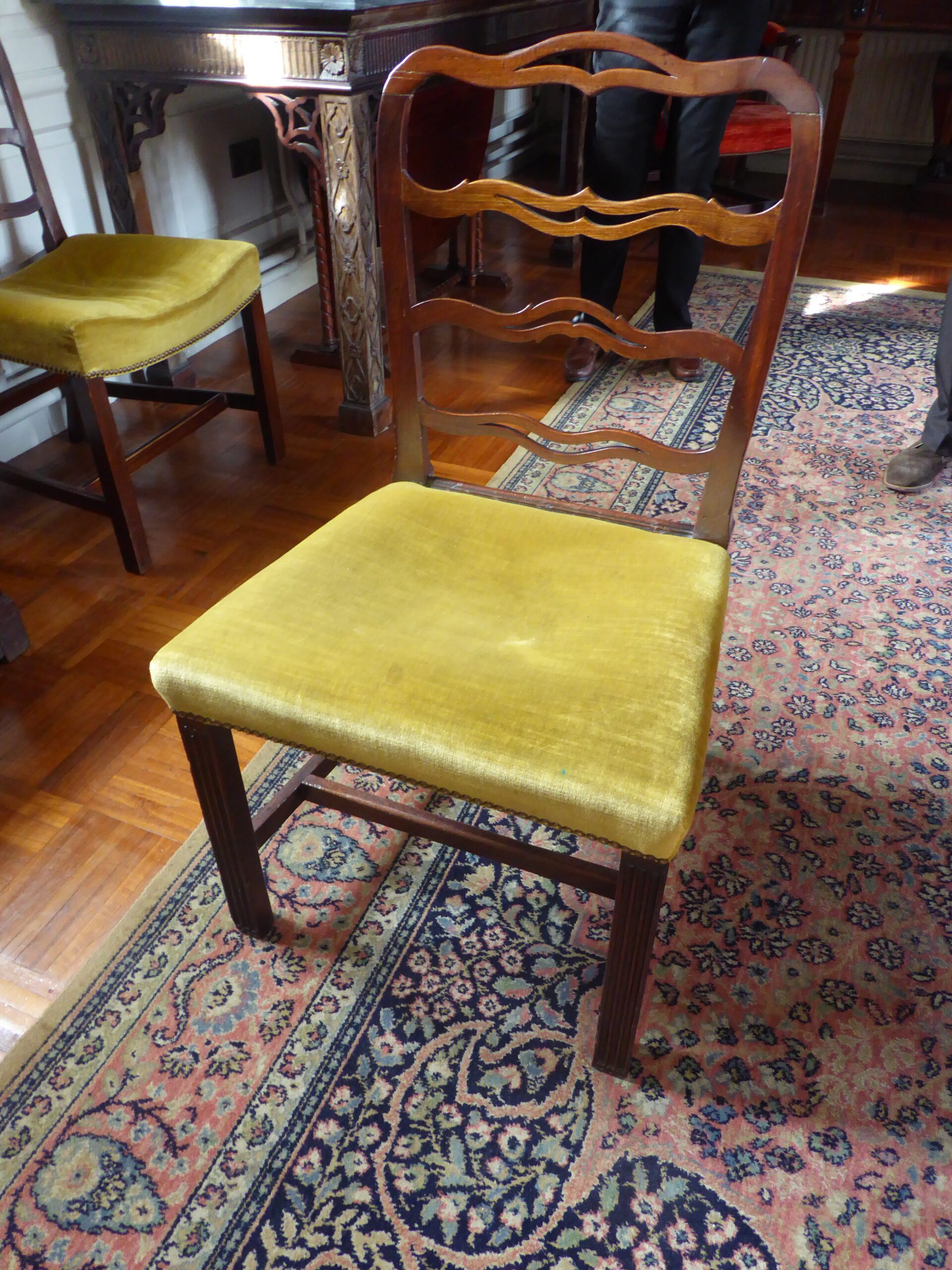
One of the dining chairs at Penicuik House
Of documentary interest are estimates and accounts submitted to William Nesbitt for the complete furnishing of Archerfield House, East Lothian, in 1777[11]. The final account came to over five hundred pounds, and the principal rooms reflect James’s letter very closely[12]. In the same year the Hamiltons compiled an inventory of the furniture at Hamilton Palace[13], one of the largest houses in Scotland, and then submitted an estimate for providing furniture and refurbishing the Palace for the sum of £ 1237 5/ 7d[14]. Samples from the furniture suggested include
A handsome Bedstead with Mahogany foot posts in the Gothick taste … mounted with Copperplate Calicoe – Pattern the Seasons Colours Purple and white, lined with white Cotton cloth, trimmed with white fringe and finished with an open Cornice japanned of suitable colours £ 27 18/ [with a] Bed Cover of the same Calicoe lined and bound £ 3 8/
and curtains and ‘back and seat’ chairs covered to suit[15]. For the High Dining Room ‘12 handsome Mahogany relieved split back’d Chairs in hair Cloth and brass Nails’ were recommended at twenty two shillings and sixpence each, and a
Waterpot Cupboard in form of a handsome Pedestal – Water Urn at Top and lead in Drawer below £ 6 10/.
And finally, for the New Drawing Room, ‘Two Elegant Card Tables inlaid of different woods and one Tea table to suit’ at twenty five pounds for the set, a very considerable sum[16]. The Hamiltons concluded by stating that
The Expence of the foregoing articles will not exceed the price Extended to Each in the foregoing estimate and in the progress of the work the utmost attention will be paid to save everything unnecessary and reduce the Charge in the most reasonable manner. The old Tapestry of the Walls to be fitted as Carpets to the Stewards Room and different Bedrooms so far as can be made extend. The Calculations are made from the Papers Chintz, & Silk Tabberay made choice of and the Patterns approved of by the Duke of Hamilton.
On William Hamilton’s retirement in 1790[17] his son James decided to combine forces with the Hamiltons’ great competitor Young and Trotter, Hamilton selling that stock of his which was surplus to requirements and disposing of his warehouse[18]. The new company Young, Trotter & Hamilton commenced on the 26th April 1790[19] and was responsible for the furnishing of Holyroodhouse for the Comte d’Artois, one of the outstanding commissions of the age in Scotland, and still surviving in the public areas and King’s private apartments at Holyrood.
This pair of chairs is an exceptional example of 18th century Scottish cabinet making. They are documented to one of the most successful makers in Scotland, fully provenanced to one of the most significant patrons and houses of the age . They were subsequently featured in the family’s main reception room and constitute a significant link in the history of the famous cockpen form. They are also in lovely original condition.
Sebastian Pryke
July 2024
Bibliography
Francis Bamford ‘A Dictionary of Edinburgh Wrights and Furniture Makers 1660-1840’ Furniture History XIX 1983
Sebastian Pryke ‘Cockpen Quest” Country Life 29th April 1993 pp80-81
Sebastian Pryke ‘The Eighteenth century Furniture Trade in Edinburgh’ St Andrews University doctoral thesis 1995
Notes
[1]NLS MS17630/216. For a discussion of pattern furniture see Chapter IV.
[2]In the Tolbooth Wynd, Canongate.
[3]G Hamilton The House of Hamilton p34.
[4]EA 26th December 1766.
[5]Caddell’s other partnerships tended not to be very long lived. See APPENDIX II. In 1784 Hamilton and his son buried Lady Susana Keith on their own account. AU MS3064/276.
[6]To Mr Balfour Ramsay. GD288/262.
[7]When Hamilton and Son made a ‘Gout chair’ for Lord Hopetoun for the grand sum of thirteen guineas. NRA(S)888/525.
[8]pp29-31. I have not seen the original but it is in the Gardie House MSS, Orkney; NRA(S)450. Belmont still stands, but is derelict. It is the northernmost classical house in Scotland.
[9]Including the £ 33 14/ 9d ‘in full of Chairs for Dining Room’ in 1772. GD18/1758a Journal of Expenses.
[10]Hamilton was paid £ 38 12/ 9d for ‘48 Chairs and Two Armed Do’, most of which still survive in the 19th century incarnation of Trinity House. They are made of elm, in contrast to the mahogany ones at Penicuik. GD226/4/6 Volume of Minutes 3rd August 1774. Young and Trotter made the curtains; 28th April 1775. The large armchairs have comparable details to the pairs at Penicuik (see below). See S Pryke ‘Cockpen Quest’ Country Life 29th April 1993 pp80-81.
[11]There is also an account to the Earl of Kintore for Keith Hall in 1779, which came to just over five hundred pounds.
AU MS3064/276.
[12]The furniture has long since been dispersed. GD205/48/18/1/19, 20 & 24.
[13]Thirty eight pages long. NRA(S)2177/100/10.
[14]ibid . I am indebted to the late Margaret Swain for photocopies of these documents, and the corresponding reference.
[15]A similar bed for the Duke, ‘mounted with silk Tabberay’ was estimated at £ 56 10/ , the extra cost essentially being in the fabric.
[16]There are some tables now in the Drawing Room at Lennoxlove, East Lothian (the present seat of the Dukes of Hamilton) which correspond to this description, but it takes a considerable leap of faith to believe that they could have the survived the vicissitudes of two enormous sales, a demolition and a move. All the furniture at Lennoxlove did, however, come from Hamilton Palace, so it is possible.
[17]Announced in the EEC on the 11th March.
[18]EEC 19th March 1791.
[19]EEC 8th August 1790.